Unlike most ladybird beetles — which are welcome garden allies — Henosepilachna vigintioctopunctata (previously known as Epilachna vigintioctopunctata), a cryptic species complex, is a strict herbivore capable of reducing an entire crop to skeletal, papery husks. Other common names include Epilachna beetle, spotted ladybird beetle, or 28-spotted potato beetle. Here is what growers and agronomists need to know. This insect species is distributed across East and Southeast Asia, and recently has expanded to Australia and Central Asia.

Taxonomy
Phylum: Arthropoda
Class: Insecta
Order: Coleoptera
Family: Coccinellidae
Genus: Henosepilachna
Species: vigintioctopunctata
Spots per beetle: 28
Generations per year: up to 7
Days to complete a cycle: 20 – 50
Eggs per cluster: 5 – 45
Why this pest matters
Both adults and larvae attack the same foliage, feeding by scraping away the chlorophyll-rich parenchyma. The result is characteristic “windows” that dry, brown, and fall out, leaving a lace-like skeleton. Severe infestations strip photosynthetic tissue entirely, stunting growth and triggering fruit drop.
Emerging concern: Recent research indicates that feeding by this beetle can act as a mechanical vector for Tomato brown rugose fruit virus (ToBRFV), significantly amplifying its economic threat.
Host range
The beetle is primarily a solanaceous pest, but will shift hosts under pressure:
Primary hosts: Brinjal/eggplant, Potato, Tomato, Peppers
Secondary and reservoir hosts: Bitter gourd, Cucumber, Melons, Wild solanaceous weeds
Wild solanaceous weeds act as off-season reservoirs, sustaining populations between cropping cycles.
Life cycle at a glance
Egg: Cigar-shaped, pale yellow. Laid in clusters of 5–45 on leaf undersides. Hatch in 2–5 days.

Credit: Surendra Dalal
Larva (4 instars): Yellowish with six rows of branched black spines. Gregarious early; the 4th instar causes the most damage. Lasts 9–28 days.
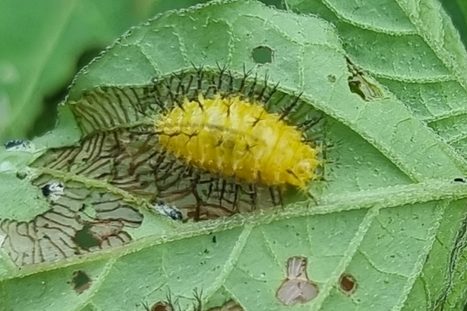
Credit: Arun Kumar
Pupa: Hemispherical, initially bright yellow. Anchored to a leaf or a stem. Duration: 3–6 days.

Credit: Arun Kumar
Adult: 6–7 mm, bronze-red with 28 black spots. Lives 3–4 weeks; females can lay several hundred eggs.

Integrated pest management
Effective control requires layering complementary tactics to reduce selection pressure for insecticide resistance.
Cultural
Handpicking & sanitation: Remove yellow egg masses and spiny grubs by hand in small plots. Destroy crop residues post-harvest to eliminate overwintering adults.
Weed management: Eliminate wild solanaceous weeds at field borders to cut off the off-season reservoir and slow re-infestation.
Biological
Pediobius foveolatus: This eulophid parasitic wasp efficiently parasitises larval stages and is a cornerstone of biological suppression.
Predator conservation: Limit broad-spectrum sprays to protect assassin bugs, shield bugs, and spiders — natural regulators of beetle populations.
Biorational
Neem/spinosad: Azadirachtin disrupts feeding and growth. Spinosad provides targeted larval kill with low impact on beneficials.
Chemical (threshold-based)
Conventional options: Selective neonicotinoids/IGRs (e.g., novaluron) — apply only when action thresholds are exceeded.
Regular scouting — particularly of leaf undersides for egg clusters and early-instar larvae — remains the most cost-effective early warning system available to growers.
Resources for further reading
- Kobayashi et al. 2000. Two Cryptic Species of Epilachna vigintioctopunctata in Asia. https://doi.org/10.2108/zsj.17.1159.
- Jamwal et al. 2017. Seasonal abundance of Henosepilachna vigintioctopunctata (Fab.) on Solanum melongena L. in Jammu, India. https://doi.org/10.1590/1678-4324-2017160455.
- Wang et al. 2025. The role of Henosepilachna vigintioctopunctata in facilitating the spread of Tomato Brown Rugose Fruit Virus (ToBRFV) among hosts. https://doi.org/10.3390/insects16121225.
- Pakkirisamy et al. 2024. Preference of brinjal hadda beetle, Henosepilachna vigintioctopunctata (Fabricius) (Coccinellidae: Coleoptera) to different solanaceous weed plant hosts. https://doi.org/10.5958/0974-4541.2024.00010.7.
- Kumar et al. 2022. Integrated approach for management of hadda beetle (Henosepilachna vigintioctopunctata Fabricius).
Leave a Reply