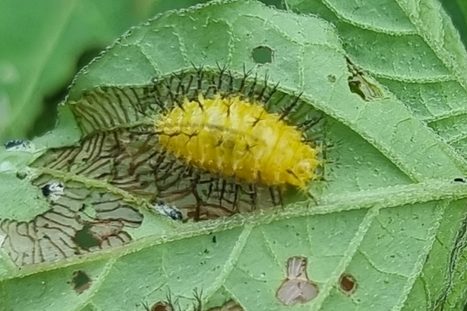
Unlike most ladybird beetles — which are welcome garden allies — Henosepilachna vigintioctopunctata (previously known as Epilachna vigintioctopunctata), a cryptic species complex, is a strict herbivore capable of reducing an entire crop to skeletal, papery husks. Other common names include Epilachna beetle, spotted ladybird beetle, or 28-spotted potato beetle. Here is what growers and agronomists need to know. This insect species is distributed across East and Southeast Asia, and recently has expanded to Australia and Central Asia.
Adult hadda beetle resting on the flower bud of bitter gourd.
Taxonomy
Phylum: Arthropoda
Class: Insecta
Order: Coleoptera
Family: Coccinellidae
Genus: Henosepilachna
Species: vigintioctopunctata
Spots per beetle: 28
Generations per year: up to 7
Days to complete a cycle: 20 – 50
Eggs per cluster: 5 – 45
Why this pest matters
Both adults and larvae attack the same foliage, feeding by scraping away the chlorophyll-rich parenchyma. The result is characteristic “windows” that dry, brown, and fall out, leaving a lace-like skeleton. Severe infestations strip photosynthetic tissue entirely, stunting growth and triggering fruit drop.
Emerging concern: Recent research indicates that feeding by this beetle can act as a mechanical vector for Tomato brown rugose fruit virus (ToBRFV), significantly amplifying its economic threat.
Host range
The beetle is primarily a solanaceous pest, but will shift hosts under pressure:
Effective control requires layering complementary tactics to reduce selection pressure for insecticide resistance.
Cultural
Handpicking & sanitation: Remove yellow egg masses and spiny grubs by hand in small plots. Destroy crop residues post-harvest to eliminate overwintering adults.
Weed management: Eliminate wild solanaceous weeds at field borders to cut off the off-season reservoir and slow re-infestation.
Biological
Pediobius foveolatus: This eulophid parasitic wasp efficiently parasitises larval stages and is a cornerstone of biological suppression.
Predator conservation: Limit broad-spectrum sprays to protect assassin bugs, shield bugs, and spiders — natural regulators of beetle populations.
Biorational
Neem/spinosad: Azadirachtin disrupts feeding and growth. Spinosad provides targeted larval kill with low impact on beneficials.
Chemical (threshold-based)
Conventional options: Selective neonicotinoids/IGRs (e.g., novaluron) — apply only when action thresholds are exceeded.
Regular scouting — particularly of leaf undersides for egg clusters and early-instar larvae — remains the most cost-effective early warning system available to growers.
Wang et al. 2025. The role of Henosepilachna vigintioctopunctata in facilitating the spread of Tomato Brown Rugose Fruit Virus (ToBRFV) among hosts. https://doi.org/10.3390/insects16121225.
Pakkirisamy et al. 2024. Preference of brinjal hadda beetle, Henosepilachna vigintioctopunctata (Fabricius) (Coccinellidae: Coleoptera) to different solanaceous weed plant hosts. https://doi.org/10.5958/0974-4541.2024.00010.7.
Kumar et al. 2022. Integrated approach for management of hadda beetle (Henosepilachna vigintioctopunctata Fabricius).
Brinjal Shoot and Fruit Borer (BSFB), Leucinodes orbonalis Guenee (Lepidoptera: Crambidae), is a monophagous pest (feeds only on Brinjal/Eggplant). This insect species is a very important pest on brinjal owing to its feeding habit. By habit, this pest is an internal borer that damages the tender shoots and fruits. The normal reactive measures, like spraying pesticides, do not solve the problem. The usage of highly systemic poisons at a very high frequency makes the vegetables poisonous, ecologically unsafe, and economically unviable. This excessive pesticide usage threatens the health of farmers and consumers, besides making brinjal more costly to consumers. In the meantime, the insect is becoming tolerant to the chemicals, making it more difficult to control. But if we understand the nature and behavior of each life stage of the cycle, it is easy to replace poisonous chemicals with knowledge, local resources, and skills. The BSFB is a major insect pest of brinjal in Asia, which causes serious damage, especially during the fruiting stage. The percent fruit infestation caused by the pest reached up to 90.86% (Rahman, 1997). Various insects cause enormous losses to this vegetable throughout the season in Bangladesh as well as in the Indian subcontinent (Alam, 1969, and Dhankar, 1988), among them, BSFB is the most serious and destructive one. Due to the attack of this pest, considerable damage occurs each year, affecting the quality and yield of the crop. Only the larvae of this pest cause 12-16 % damage to shoots and 20-60% to fruits (Alam, 1970; Maureal et al., 1982). The pest is very active during the rainy and summer seasons and often causes more than 90% damage (Ali et al., 1980; Kalloo, 1988). The yield loss has been estimated up to 86% (Ali et al., 1980) in Bangladesh and up to 95% (Naresh et al., 1986) in India.
Distribution
The BSFB is reported from regions of aubergine cultivation in Africa, south of the Sahara, and South-East Asia, including China and the Philippines. In South Asia, it is widely spread in Bangladesh and India. A little presence in Nepal is found.
Host Range
Major hosts: Solanum melongena (aubergine), Solanum tuberosum (potato)
Adults are white with a characteristic wing pattern. The wing span of the adult is 18-24 mm. Forewing is antemedian field brown, the median field has a large brown patch near the inner margin, and the reniform stigma is brown. In the postmedian field, a black patch is present near the apex. A black patch is on the cross-vein of the cell in the hind wing. Postmedian line diffuse, black with some black spots in the postmedian field.
Biology
Egg
Adult females lay eggs on the foliage (Figure 1). The number of eggs laid by an average female varies from 80 to 253. Oviposition occurs at night, and eggs are laid singly on the lower surface of young leaves, green stems, flower buds, or fruit calyces. Eggs are flattened, elliptical, and 0.5 mm in diameter. They are creamy white soon after they are laid, but turn red before hatching. Eggs hatch in 3 to 6 days. Prabhat Kumar and Johnsen (2000) found that adults were most active between 02.00 and 06.00 h. Most of the feeding, mating, and egg laying occurred during this period, which lasted about 16 minutes. Eggs were laid in the early hours of the morning, singly or in batches, on the ventral surface of the leaves.
Larva
Soon after hatching from eggs, young caterpillars search for and bore into tender shoots near the growing point, into flower buds, or into the fruits. Caterpillars prefer fruits over other plant parts. Larvae go through at least five instars (Atwal, 1976), and there are reports of the existence of six larval instars. The larval period lasts 12 to 15 days in the summer and up to 22 days in the winter. (Prabhat Kumar and Johnsen, 2000) A total of six larval instars have been recorded. Climatic conditions are important in the life cycle of the borer. As temperature increases and humidity decreases, fecundity increases, and the duration of the life-cycle decreases. The larval period was the longest, followed by the pupal and egg stages. Sandanayake and Edirisinghe (1992) studied the larval distribution on mature eggplant in Sri Lanka. They found first instars in flower buds and flowers, second instars in all susceptible plant parts, third and fourth instars in shoots and fruits, and fifth instars mostly in fruits. Larval feeding on fruit and shoots is responsible for the damage to the eggplant crop. A full-grown larva measures 18 to 23 mm in length.
Pupa
Mature larvae come out of their feeding tunnels and pupate in tough silken cocoons among the fallen leaves and other plant debris on the soil surface near the base of eggplant plants. The color and texture of the cocoon match the surroundings, making it difficult to detect (Figure 1). Some studies indicate the presence of cocoons at soil depths of 1 to 3 cm. The pupal period lasts 6 to 17 days, depending upon temperature.
Adult
Moths come out of their pupal cocoons at night. Young adults are generally found on the lower leaf surfaces following emergence. The BSFB females are slightly bigger than the males. The abdomen of the female moth tends to be pointed and curl upwards, whereas the male moth possesses a blunt abdomen. The moth is white but has pale brown or black spots on the dorsum of the thorax and abdomen. Wings are white with a pinkish or bluish tinge and are ringed with small hairs along the apical and anal margins. The forewings are ornamented with several black, pale, and light brown spots. The moth measures 20 to 22 mm across the spread of wings. Longevity of adults was 1.5 to 2.4 days for males and 2.0 to 3.9 days for females. The pre- Oviposition and Oviposition periods were 1.2 to 2.1 and 1.4 to 2.9 days, respectively (Mehto et al., 1983).
Baang and Corey (1991) reported six larval instars in the Philippines. The egg, larval, and pupal periods were 6, 15, and 11.5 days, respectively; the average longevity of males and females was 4 and 7.5 days, respectively. Mehto et al. (1983) reported that in India, the egg, larval, and pupal periods were 5.4, 17.5, and 9.8 days, respectively; the lifespan of adult males and females was 1.5-2.4 and 2.0-3.9 days, respectively. The number of eggs produced per female ranged from 84.5 in January to 253.5 in May. In Ghana, the young larvae bore into young axillary shoots, causing wilting. They enter the fruits and plug the small entrance holes with excreta. Fruits contain up to 20 larvae (Frempong, 1979). Sandanayake et al. (1992a) determined the larval instars by measuring the size of the head capsules; they also studied larval distribution on aubergine in Sri Lanka. First-instars larvae were found in flower buds and flowers; second-instars larvae were present in all susceptible parts of the plant; larvae were confined to the shoots and fruits in the third and fourth instars; and fifth-instars larvae were found only in the fruits.
Nature of Damage
Within one hour after hatching, BSFB larvae bore into the nearest tender shoot, flower, or fruit. Soon after boring into shoots or fruits, they plug the entrance hole with excreta. In young plants, caterpillars are reported to bore inside the petioles and midribs of large leaves. As a result, the affected leaves may drop off (Butani and Jotwani, 1984).
The presence of wilted shoots in an eggplant field is the surest sign of damage by this pest. The damaged shoots ultimately wither and drop off. This reduces plant growth, which in turn reduces fruit number and size. New shoots can arise, but this delays crop maturity, and the newly formed shoots are also subject to larval damage.
Larval feeding in flowers—a relatively rare occurrence—results in failure to form fruit from damaged flowers. The feeding tunnels are often clogged with frass. This makes even slightly damaged fruit unfit for marketing. The yield loss varies from season to season and from location to location. Damage to the fruits in India, particularly in autumn, is very severe, and the whole crop can be destroyed (Atwal, 1976). The BSFB is active throughout the year at places with a moderate climate, but its activity is adversely affected by severe cold. This insect species is practically monophagous, feeding principally on eggplant; however, other plants belonging to the family Solanaceae are reported to be hosts of this pest. They include tomato (Lycopersicon esculentum), potato (Solanum tuberosum), selected nightshades (S. nigrum and S. indicum), and turkey berry (S. torvum).
Management
Cultural Method
Collection, destruction of dried shoot tips and bored fruits on a campaign basis in an area is an efficient method because the larvae tend to pupate (transform into pupa and take rest) in the plant residues themselves. Burning of the infested parts and composting the crop remains is useful in preventing the buildup of the moth populations in a given area. After the final harvest, the old plants should be uprooted and burned promptly because they may harbor BFSB larvae, which could become a source of future infestation. In West Bengal, India, Karmakar and Bhattacharya (2000) showed that the pest population can be maintained at well below the economic injury level (0-11.75 L. orbonalis Guen. /plot) using mechanical methods of control.
Crop rotation is beneficial as the insect survives only on brinjal. Avoid continuous cropping of the brinjal crop. Intercropping brinjal with other crops like cowpea, maize, and coriander should be done which improves the natural habitat for natural enemies (like spiders, lace wings, ladybirds, etc.) against the pest. Intercropping coriander with aubergine may be useful in IPM programmes against L. orbonalis by reducing fruit infestation and the amount of insecticide used by farmers (Khorsheduzzaman et al., 1997).
Erection of a barrier around the field plot is one of the methods to control borer infestation. The net barrier is made 2-3 m high around the plot. This method restricts the movement of adult BSFB and eventually reduces the infestation. The use of the barrier along with sanitation reduces the shoot damage to an average of 62.7% compare to others without this practice (Alam et al., 2003).
Host-Plant Resistance
Several varieties of aubergine have been evaluated for resistance against infestation by L. orbonalis. Resistance in varieties SM 17-4, PBR 129-5, and Punjab Barsatiby was attributed to a large number of small fruits per plant with shorter inter/intracluster distance, late fruiting and a longer fruiting period (Dilbagh-Singh et al., 1991). Biochemical characters, such as total sugars and free amino acids, were positively correlated with fruit infestation, and polyphenol content was negatively correlated with attack (Darekar et al., 1991). Bajaj et al. (1989) suggested that the presence of glycoalkoids in association with phenolic compounds was responsible for the resistance in variety SM-17-4.
In Himachal Pradesh, India, Chaudhary and Sharma (2000) found that the aubergine variety Arka Kesav had a fruit borer incidence of 2.88 compared to 5.64 in variety SM 6-6. The highly resistant aubergine variety, Sm-202, had tightly arranged seeds in the mesocarp (Lal, 1991). Mishra et al. (1988) attributed resistance in long-fruited varieties to thick fruit skin and closely packed vascular bundles in the pulp. In Tamil Nadu, India, Thangamani et al.( 2011) found that the hybrid COBH-1 is the only hybrid with the highest marketable fruit yield per plant with the lowest fruit borer infestation. Two hybrids, viz., COBH-1 and KBHL-3 of SAU, and the three F1 hybrids evolved from ICAR institutes Viz, Pusa Hybrid-5, DBHL-14, and IVBHL-54, and the Private Institutes hybrids Viz, ARBH-785 and PK-123, possess higher marketable fruit yield per plant. Hossain M. et al. (2002) reported that the brinjal shoot and fruit borer infestations for different varieties/lines were found in the following order of intensity: Nayankajal> BL095> BL085> BL098> BLO114> Khotkhotia-2> Berka> Laffa> lslampuri> BL045> Ohohazari-2> BL0101> Ohohazari-1> Khotkhotia-1> BL096> Sada ball> Singnath> Uttara> Baromashi> Jhumki.
Biological Control
Several parasitoids and predators of BSFB are prevalent in the brinjal fields in South and Southeast Asian countries. The most notable parasitoid is Trathala flavoorbitalis, a tiny wasp that is harmless to humans. This wasp lays its eggs in BSFB larvae. The eggs hatch into wasp larvae that eat the BSFB larvae they were laid into.
Predators: Campyloneura sp. (a bug), Cheilomenes sexmaculata (a ladybird beetle), Coccinella septempunctata (seven-spotted ladybird beetle), Brumoides suturalis (three-striped ladybird)
Parasitoids: Pseudoperichaeta sp., Phanerotoma sp., Itamoplex sp., Eriborus argenteopilosus, Diadegma apostata. Release egg parasitoid: Trichogramma chilonis @ 50,000/ ha, four times from 30 DAT
Entomopathogens: Fungus (Bipolaris tetramera), Baculovirus, Nuclear polyhedrosis virus. Spray Bacillus thuriengiensis var kurstaki @ 1500 ml/ ha (750 litres of spray fluid)
Chemical Control
Insecticides are currently the main method of control for L. orbonalis. Contact insecticides are the most commonly used and show varying degrees of efficacy against the pest. Deltamethrin and endosulfan were the most effective insecticides used in South Asia (Thanki and Patel, 1991).
In field experiments conducted in Andhra Pradesh, India, triazophos and methomyl were applied when >20% of aubergine fruits were infested; the highest fruit yields and returns were obtained with triazophos (Radhika et al., 1997). From the survey done in Orissa, India (Babu et al.,2002), it was found that the most commonly used insecticide in the field was carbaryl, followed by endosulfan, carbofuran, and cypermethrin. In the nursery, however, the majority of the farmers (81.4%) did not follow any control measures, and only 13.00% of the farmers used carbaryl spray. The majority of the farmers (41.7%) followed a 7- to 8-day spraying, and nearly 30% followed a 9- to 12-day spraying. Spray endosulfan 35 EC @ 2 ml/lit + neem oil 2ml/lit, Quinalphos 25 EC @ 1ml/lit + neem oil 2ml/lit, Neem seed kernel extract (NSKE) 5 %.
Sharma and Chhibber (1999) tested deltamethrin, endosulfan, and neem oil against L. orbonalis in India. Six sprays of Deltamethrin were the most economical treatment, and neem oil treatment was the least economical. Kumar and Babu (1998) compared two commercial neem formulations against each other and against endosulfan. A 5% Azadirachtin treatment showed more ovipositional deterrent effects than a 1% formulation of endosulfan. However, endosulfan was superior with respect to ovicidal effects. A combination of cypermethrin/deltamethrin and triazophos/endosulfan, sometimes combined with cartap hydrochloride and diflubenzuron, gave higher yields than non-treated plots; cypermethrin/deltamethrin mixtures were most effective Kumar et al., 2000, 2001; Biradar et al., 2001).
(Latif M.A. et al., 2006) A field experiment in Bangladesh revealed that spraying of flubendiamide at 2% shoot + 2% fruit infestation against the brinjal shoot and fruit infestation reduced the shoot and fruit infestation, and increased the marketable healthy fruit yield of brinjal. On the other hand, flubendiamide spray at 5% fruit infestation gave similar results for the yield of brinjal but reduced the number of insecticide applications and increased the BCR by about 2.5 times. This would have a positive impact on the environment, reduce toxic residue load on brinjal fruits, and finally, the cost of control measures would be minimized significantly. Therefore, 5% fruit infestation may be considered as the best threshold for application of flubendiamide in managing the brinjal shoot and fruit borer of brinjal.
Pheremonal Control
Sex pheromones can be used to trap male EFSB moths. A 2-3 mg pheromone sample contained in a porous plastic tube, when baited in a suitable trap and placed in the field, can attract male moths continuously for up to 6 weeks. It is the smell of the pheromone seeping from the lure tube that attracts male EFSB moths. They enter the trap, fly around the lure, and fall into the soapy water and die. It is important that the soapy water inside the trap is replenished often to make sure the trap is never dry, or else the moths will not be killed. This trap can last at least one season.
No matter what type of pheromone trap is used, the lure tube should always be kept closed. Pheromone chemical seeps slowly and uniformly from this tube. Traps should be erected in the field starting 3-4 weeks after transplanting until the last harvest. A distance of 10-15 m should be maintained between traps in the field. The traps are hung in such a way that the lure is just above the plant canopy. This will require that the traps be moved higher as plants grow taller. Cork et al. (2001) optimized different blends of the female sex pheromone in West Bengal, India. Blends containing 1 and 10% E11-16/OH caught more male L.orbonalis than E11-16Ac alone. Different trap structures were evaluated in the study. Chatterjee H. (2009) developed a module with three components, i.e., pheromone trap, timely mechanical control, and application of azadex (neem-based insecticides), which was found most effective in the reduction of shoot damage (76.59%) followed by the farmer’s practice (i.e., twenty times application of insecticides) (76.36%).
IPM
Islam et al. (1999) investigated the management of BSFB using insecticides applied at 10% action threshold level (ATL) and at the peak of adult emergence (POAE), and by applying mechanical control, which resulted in reduced applications (4-7) compared to scheduled sprays (16) and reduced the fruit damage. The benefit cost ratio (BCR) (12-15) was about three times lower than in the ATL and POAE treated plots (28-38). A hymenopterous parasitoid wasp of L. orbonalis was less affected in the IPM intervention plots than in the scheduled spray plots. Sasikala et al. (1999) compared the efficacy of ecologically friendly methods of control in Bapatla, India. Treatments included neem seed kernel extract, neem oil, Bacillus thuringiensis var. kurstaki, lufenuron, carbaryl, combination treatments, mechanical removal, and the destruction of infested shoots and fruits, and release of the egg parasitoid, Trichogramma japonicum. Mechanical destruction of infested shoots and fruits, neem oil, and the release of T. japonicum gave good control of L. orbonalis compared to the control. Plots treated with neem oil, neem oil + Bt, neem oil + lufenuron, and neem oil + carbaryl gave higher fruit yield than the untreated control plots.
Chakraborti (2001) assessed the effectiveness of a biorational integrated approach for the management of aubergine Pusa Purple Cluster L. orbonalis using the application of fresh neem cake in the nursery at land preparation, every 30 days after transplanting, foliar application of neem seed kernel extracts at 7-day intervals beginning 30 days after transplanting, root zone application of benzene once every 30 days after transplanting, clipping and destruction of infested plant parts, and a single application of carbofuran 30 days after transplanting. A low mean shoot and fruit infestation (4.92 and 5.32%, respectively) was recorded with this treatment, whereas the chemical method failed to afford adequate protection and recorded 20.42 and 25.24% mean shoot and fruit infestation, respectively. Sudhakar et al. (1998) studied the influence of fertilizers and insecticides on the damage potential of L. orbonalis. A higher dose of potash, along with the chemical treatments carbaryl + dicofol, malathion, and bifenthrin, was effective against L. orbonalis; the percentage of aubergines damaged on a weight basis was also low in these treatments. A lower dose of potash resulted in higher shoot (14.4%) and fruit (44.3%) infestation, on a par with the control. The highest marketable fruit yields, 7.7 and 6.7 t/ha, were recorded with bifenthrin and the higher dose of potash, respectively. Lowest marketable fruit yields, 1.6 and 2.1 t/ha, were obtained in plots treated with neem cake and vermicompost.
Naitam and Mali (2001) used combinations of insecticide mixtures and natural enemies in the field. The highest cost-benefit ratio (1:9.95) was recorded in a treatment of B. thuringiensis var. kurstaki + monocrotophos. Rabinda and Prasad (2001) found significant suppression of L. orbonalis when aubergine was grown in association with either marigold (Tagetus erecta) or okra (Abelmoschus esculentus) in Bihar, India. Removal and destruction of twigs/fallen leaves twice in a week + Bt @ 0.5 kg/ha showed minimum infestation of shoot (1.23 and 1.13%) and fruits (1.10 and 0.90%), and produced maximum healthy fruits over the rest of the treatments in managing the shoot and fruit borer infestation, followed by neem gold @ 2 mill + mechanical removal (T1). Cypermethrin @ 0.016% and imidacloprid @ 0.015% were found next most effective treatment in order of efficacy (Ghanand T., 2002).
Conclusion
Brinjal Shoot and Fruit Borer is a serious pest of brinjal in the South Asia region. The damages caused by BSFB reduce a great amount of yield and incur huge economic losses. There are different types of management followed for the control of this insect. The most economical and eco-friendly means of management is IPM, which helps to manage the insects in large numbers. To control the insect, we should first understand the biology of the insect and its predators and parasites. It should be controlled in a natural way by encouraging its predators. The use of bio-pesticides is very much preferable to toxic chemicals.
The indiscriminate use of toxic, broad-spectrum insecticides is not giving satisfactory control of EFSB. At the same time, these pesticides are killing the natural enemies of EFSB. These natural enemies were giving satisfactory control of the pest before the use of insecticides became widespread. Broad-spectrum chemicals sprayed to kill EFSB will also kill these beneficial insects. If selective, preferably biological insecticides are used instead, this and many other parasitoids will survive and be able to attack EFSB larvae. Reducing the use of pesticides will allow common predators, such as spiders, ants, earwigs, and mantids, to survive and kill EFSB and other pests. These natural enemies are important assets of vegetable farmers and should be protected by reducing or, if feasible, eliminating broad-spectrum chemical pesticide use. If one must apply insecticides to combat EFSB or other pests, it is important that only the locally recommended and still effective insecticides, and preferably, pest-specific biological products, be used.
References
Alam, M.Z. 1969. Insect pests of vegetables and their control in East Pakistan. Agril. Inf. Serv., Department of Agriculture. 3, R.K. Mission Road, Dacca-3, East Pakistan. 146 p.
Alam, M.Z. 1970. Insect pests of vegetables and their control in Bangladesh. Agril. Inf. Serv. Dacca, Bangladesh. 132 p.
Ali, M.I., Ali, M.S., and Rahman, M.S. 1980. Field evaluation of wilt disease and shoot and fruit borer attack of different cultivars of brinjal. Bangladesh J. Agril. Sci. 7(2): 193-194.
Atwal, A.S. 1976. Agricultural pests of Indian and Southeast Asia. New Delhi: Kalyani Publishers. 529 pp.
Baang LA, Corey FM, 1991. Life history of an eggplant fruit and shoot borer, Leucinodes orbonalis (Guen) (Lepidoptera: Pyralidae). CMU Journal of Science, 4(1):45-61.
Babu, B. S.; Varaprasad, K. S.; Anitha, K.; Prasada Rao, R. D. V. J.; Chakrabarty, S. K.; Chandurkar, P. S., 2002. Brinjal shoot and fruit borer (Leucinodes orbonalis) status in coastal districts of Orissa. Resources management in plant protection during twenty first century, Hyderabad, India, 14-15 November 2002. Volume II 2002 pp. 121-123
Bajaj, K, L. D. Singh, and G. Kaur. 1989. Biochemical basis of relative field resistance of eggplant to the shoot and fruit borer. Veg. Sci. 16(2): 145-149.
Biradar AP, Teggelli RG, Patil DR, Balikai RA, 2001. Evaluation of cypermethrin 3 EC+ quinalphos 20 EC(=23 EC) against brinjal shoot and fruit borer. Karnataka Journal of Agricultural Sciences, 14(2):369-372
Butani, D.K. and M.G. Jotwani. 1984. Insects in vegetables. New Delhi: Periodical Expert Book Agency. 356 pp.
Chakraborti S, 2001. A biorational approach for the management of brinjal fruit and shoot borer, Leucinodes orbonalis Guen. Journal of Entomological Research, 25(1):73-76
Chatterjee H., 2009. Pheromones for the management of brinjal fruit and shoot borer, Leucinodes orbonalis Guenee.Karnataka J. Agric. Sci., 22(3-Spl. Issue ) : (594-596) 2009
Chaudhary DR, Sharma SD, 2000. Screening of some brinjal cultivars against bacterial wilt and fruit borer. Agricultural Science Digest, 20(2):129-130
Cork A, Alam SN, Das A, Das CS, Ghosh GC, Farman DI, Hall DR, Maslen NR, Vedham K, Phythian SJ, Rouf FMA, Srinivasan K, 2001. Female sex pheromone of brinjal fruit and shoot borer, Leucinodes orbonalis, blend optimization. Journal of Chemical Ecology, 27(9):1867-1877
Darekar KS, Gaikwad BP, Chavan UD, 1991. Screening of eggplant cultivars for resistance to fruit and shoot-borer. Journal of Maharashtra Agricultural Universities, 16(3):366-369.
Dhankar, B.S. 1988. Progress in resistance studying in Eggplant (Solanum melongena L.) against shoot and fruit borer (Leucinodes orbonalis Guenee) infestation. Tropical pest management. 34: 343-345.
Dilbagh Singh, Chadha ML, 1991. Effect of morphological characters on brinjal on the incidence of Leucinodes orbonalis. Journal of Research, Punjab Agricultural University, 28(3):345-353.
Frempong E, 1979. The nature of damage to eggplant (Solanum melongena L.) in Ghana by two important pests, Leucinodes orbonalis Gn. and Euzophera villora (Fldr.) (Lepidoptera Pyralidae). Bulletin de l’Institut fondamental d’Afrique, 41(2):408-416
Ghananand T., Prasad C.S., Loknath, 2009. Integrated Management of Brinjal Shoot and Fruit Borer (Leucinodes orbonalis Guenee) in Western Uttar Pradesh. Annals of Horticulture,2 (1), 2009.
Islam N, Quiniones AC, 1990. Efficacy of endosulfan and methyl parathion in the control of the eggplant shoot and fruit borer. Bangladesh Journal of Agricultural Research, 15(1):59-63
Kalloo. 1988. Solanaceous crops. In: Vegetable Breeding. Vol. II. CRC. Press. INC BOCA Raton, Florida. pp. 520-570.
Karmakar K, Bhattacharya B, 2000. Performance of a local brinjal variety (Solanum melongena L.) and its pest management under terai agro-ecological conditions. Environment and Ecology, 18(2):344-346.
Khorsheduzzaman AKM, Ali MI, Mannan MA, Ahmed A, 1997. Brinjal-coriander intercropping: an effective IPM component against brinjal shoot and fruit borer, Leucinodes orbonalis Guen. (Pyralidae: Lepidoptera). Bangladesh Journal of Entomology, 7(1/2):85-91.
Kumar BA, Rao BN, Sriramulu M, 2000. Studies on the efficacy of certain insecticides and their mixtures against the shoot and fruit borer, Leucinodes orbonalis Guen. on brinjal. Indian Journal of Plant Protection, 28(1):25-28.
Kumar BA, Rao BN, Sriramulu M, 2001. Evaluation of insecticide mixtures against Leucinodes orbonalis Guen. on brinjal. Journal of Research ANGRAU, 29(2/3):22-26.
Kumar SP, Babu PCS, 1998. Ovipositional deterrent and ovicidal effects of Neem Azal against brinjal shoot and fruit borer and leaf beetle. Shashpa, 5(2):193-196
Lal OP, 1991. Varietal resistance in the eggplant, Solanum melongena, against the shoot and fruit borer, Leucinodes orbonalis Guen. (Lepidoptera: Pyralidae). Zeitschrift für Pflanzenkrankheiten und Pflanzenschutz, 98(4):405-410
M. A. Latif, M. M. Rahman, M. Z. Alam, M. M. Hossain, and A. R. M. Solaiman, 2009. Threshold-based spraying of flubendiamide for the management of brinjal shoot and fruit borer, Leucinodes orbonalis (Lep.: Pyralidae). Journal of Entomological Society of Iran 2009, 29(1), 1-10
M. Mofazzel Hossain, M. Shahjahan, M. Abdus Salam, and M.A. Begum, 2002. Screening of Some Brinjal Varieties and Lines Against Brinjal Shoot and Fruit Borer, Leucinodes orbonalis Guenee. Pakistan Journal of Biological Sciences 5 (10): 1032-1040, 2002.
Maureal, A.M., Noriel, L.M., and Esguerra, N.M. 1982. Life history and behaviour of eggplant fruit borer. Annal. Trop. Res. 4(3): 178.
Mehto DN, Singh KM, Singh RN, Prasad D, 1983. Biology of brinjal fruit and shoot borer, Leucinodes orbonalis Guen. Bulletin of Entomology, 24(2):112-115
Mishra PN, Singh YV, Nautiyal MC, 1988. Screening of brinjal varieties for resistance to shoot and fruit borer (Leucinodes orbonalis Guen.) (Lepidoptera: Pyralidae). South Indian Horticulture, 36(4):188-192.
Naitam NR, Mali AK, 2001. IPM of Brinjal pests using insecticide mixtures and natural enemies. Pest Management in Horticultural Ecosystems, 7(2):137-140
Naresh, J.S., Malik, V.S., Balan, J.S., and Khokhar, K.S. 1986. A new record of Trathala sp., a larval endoparasite attacking brinjal fruit borer, Leucinodes orbonalis Guenee. Bull. Ent. New Delhi. 27(1): 74.
Prabhat Kumar, Johnsen S, 2000. Life cycle studies on fruit and shoot borer (Leucinodes orbonalis) and natural enemies of insect-pests of eggplant (Solanum melongena). Journal of Applied Biology, 10(2):178-184.
Radhika S, Reddy KD, Subbarathnam GV, 1997. Management of brinjal shoot and fruit borer Leucinodes orbonalis (Guenee) with insecticides. Journal of Research ANGRAU, 25(3):10-14
Rahman, A. K. M. Z. (1997) Screening of 28 brinjal lines for resistance/tolerance against the brinjal shoot and fruit borer. Annual Research Report. Entomology Division, Bangladesh Agricultural Research Institute, Joydebpur, Gazipur, Bangladesh. 130 pp.
Sandanayake, W.R.M. and J.P. Edirisinghe. 1992. Trathala flavoorbitalis: parasitization and development in relation to host-stage attacked. Insect Science and Its Application 13(3):287–292.
Sasikala K, Rao PA, Krishnayya PV, 1999. Comparative efficacy of eco-friendly methods involving egg parasitoid, Trichogramma japonicum, mechanical control, and safe chemicals against Leucinodes orbonalis Guenee infesting brinjal. Journal of Entomological Research, 23(4):369-372.
Sharma AK, Chhibber RC, 1999. Effect of exposure periods and insecticides on Leucinodes orbonalis in brinjal. Indian Journal of Entomology, 61(3):242-251
Sudhakar K, Punnaiah KC, Krishnayya PV, 1998. Influence of organic and inorganic fertilizers and certain insecticides on the incidence of shoot and fruit borer, Leucinodes orbonalis Guen. infesting brinjal. Journal of Entomological Research, 22(3):283-286.
Thangamani C (2003). Evaluation of F1 brinjal (Solanum melongena L.) for yield and quality. M.Sc. thesis, Tamil Nadu Agricultural University, Coimbatore.
Thanki KV, Patel JR, 1991. Efficacy and economics of certain insecticides used for the control of pest complex on brinjal. Gujarat Agricultural University Research Journal, 16(2):47-51.